
10 facts on the smoking epidemic and global tobacco control,WHO website.
Although Nicaragua does not yet rank highly as a country with major problems associated with tobacco consumption, it suffers the consequences of smoking such as: damage to health, limitations on social and economic development and exacerbating the cycle of poverty.
According to WHO, Nicaragua is in the early stage of a tobacco epidemic (stage 2). Data from the Ministry of Health show that 30% of general morbidity is associated with respiratory and cardio-vascular problems and cancer due to smoking. Nicaragua has not yet implemented a concerted anti-smoking campaign and people remain largely unaware of the adverse health outcomes associated with smoking. As a result, the number of smokers continues to rise. 19% of boys in the age group 7 to 17 years smoke and 6% of girls. The average age at which young people start smoking is 12.
In the public schools of Nicaragua's capital Managua, at least 2 out of 10 students (aged 11 to 20 years) smoke. Parents and teachers are important influences: 26% of students live in homes where somebody smokes and 20% of their teachers smoke at school. Without greater awareness of the dangers of smoking to health and to social and economic well being, the number of young smokers is likely to continue to increase.
Since 2007 ICAS has worked to prevent damage to health, to the environment, and to society caused by both direct and involuntary smoke inhalation. This has been supported by technical and financial support from the state and diverse international organisations such as: Campaign for Tobacco Free Kids (TFK), American Cancer Society (ACS), International Union Against Cancer UICC), CLACCTA, International Union Against Tuberculosis and Lung Disease, Ministry of Health, Ministry of Education among others.
ICAS aims::
-
To promote and to support the approval of the bill of control of tobacco in Nicaragua, through the implementation of an action plan. ICAS has maintained communication with key decision makers both inside and outside the country.
-
To implement an education campaign to highlight the damaging health effects of tobacco and second hand smoke.
-
To discourage take-up among new smokers, particularly among adolescents and young people.
-
To promote smoke free environments in public and private spaces and to protect the population from exposure to second hand tobacco smoke.
To promote environments free of tobacco smoke ICAS is developing a pilot project to develop, apply and reinforce a smoke-free policy at the University, in collaboration with the Universidad Evangélica de Nicaragua Martin Luther King, .
ICAS has developed a Plan of Action and seeks technial and financial support for implementation. Please suppport our fight.
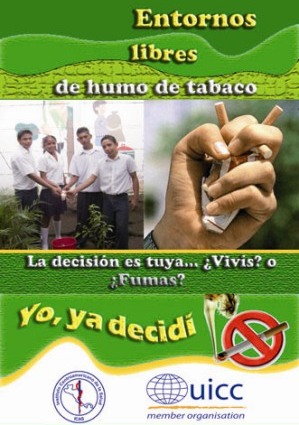
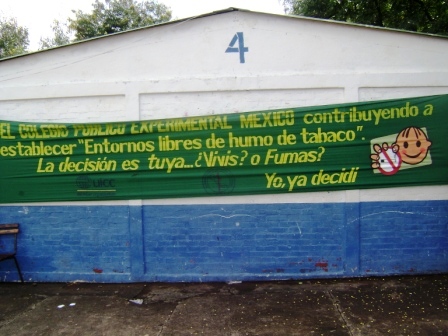
Campaign "Schools free of tobacco smoke."
In 2008 ICAS developed the first phase of the project: "Strengthening the Capacity to Fight against Tobacco in Nicaragua in an Appropriate and Effective Manner: - Achieving Smoke-Free Schools". ICAS developed a pilot campaign for primary prevention in secondary schools and presented a proposal for the second phase of this initiative. Final Report (PDF).
Some of the important achievements were:
-
Trained almost 4,000 secondary Students in smoking prevention..
- Trained 116 teachers from public schools in smoking prevention topics..
-
Participation in and facilitation of workshops and encounters, strengthening the knowledge and the technical capacity of ICAS and other organizations. 15 people from different organisations participated in the activities.
-
Coordination with Ministry of Health and Ministry of Education.
Other activities
-
22 Nicaraguan organizations have established the National Committee for the Fight against Tobacco (NCFT): (12 public/private universities, 5 medical and 5 other organizations, including ICAS). The NCFT has provided information and advocacy to the National Assembly, leading to the ratification of the Framework Convention on Tobacco Control (FCTC) on 08-04-2008, which served as the starting point to prepare and present a new law to control tobacco use.
-
On International World No Tobacco Day, 2008, the first national anti-tobacco forum was organized by several Universities, together with ICAS and other NCFT members, attended by some 1,500 persons (students, teachers, doctors, representatives of the Ministry of Health and PAHO).
-
During 2008 ICAS obtained technical and financial support from international organizations: American Cancer Society (ACS), International Union Against Cancer (UICC) and Tobacco Free Kids (TFK). With this support ICAS implemented actions to strengthen the capacity to fight smoking. ICAS achieved support from the Ministries of Health and Education and the secretariat of the National Assembly to accelerate the passing of the new tobacco law.
-
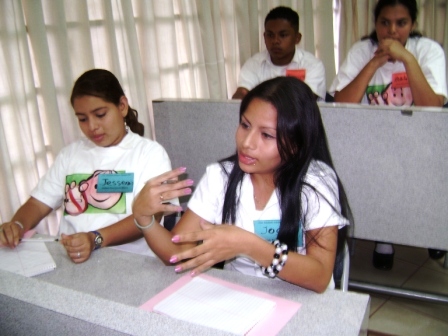
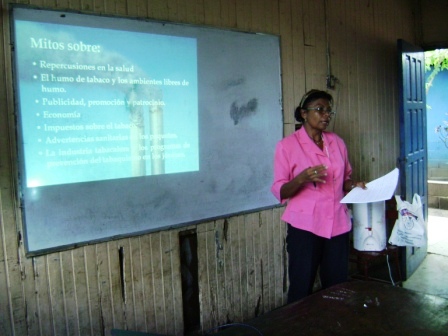
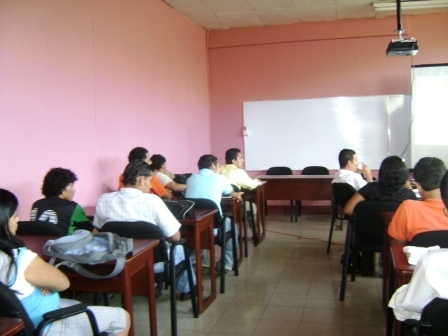
ICAS implemented a study in 2008 to identify knowledge, attitudes and practices about tobacco use in secondary schools of Managua, with support from UICC, (see annex 1 below)). From June 2008 to February 2009, ICAS implemented educational activities (workshops, mobile cinemas, murals, posters, etc.) in 5 secondary schools. The objective is to prevent smoking in schoolchildren. Over 3000 students were reached and over 100 teachers trained in at least 3 issues related to smoking (damage to health, prevention, rights of non-smokers). Summary (PDF) .
-
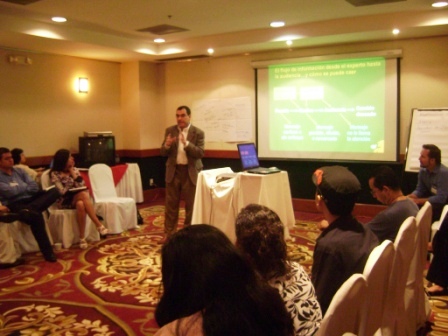
In October 2008, ICAS organized a workshop "Communication and Policies to control tobacco" with support from TKF, and 15 representatives from other organizations including NCFT and the National Assembly.
-
On 15-10-2008, ICAS organized an advocacy workshop (key elements to establish an advocacy plan to achieve the adoption of the new tobacco law) involving 13 NCFT members.
-
On 6-11-2008, ICAS organized a workshop "Smoke-free environments" with 6 NCFT members and more than 30 university students.
-
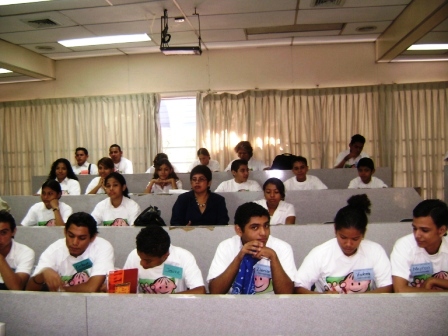
On 14-11-2008 ICAS organized the first anti-tobacco forum for students with support from the Ministry of Education and school authorities. This was attended by 60 students and 6 teachers representing 5 public schools. The forum discussed damage to health, secondhand smoke, the rights of nonsmokers and skills to resist social pressures to avoid smoking-initiation.